CHPPN Practice Test Question Bank
Preparing for the Certified Hospice and Palliative Pediatric Nurse(CHPPN) Certification Exam can be challenging, but with the right resources, success is within reach. Our expert-designed CHPPN Practice Test Question Bank offers the tools you need to feel confident and ready for exam day.
Prices
$257 - Question Bank
Comprehensive -
CHPPN®
7 - Day money back guarantee
- 700+ blueprint aligned practice questions (QBank)
- 300+ retention focused flashcards
- Unlimited access for 6 months
- Risk-free trial - Cancel within 7 days for a full refund for any reason
- Detailed analytics highlighting strengths and weaknesses
- 4 timed predictor exams
- Personalized study planner to manage your schedule
- 27 Continuing Education (CE) hours with a downloadable certificate
- Pass Guarantee
Unlimited access for 6 months for $257
$187 - Question Bank
Essentials Plan -
CHPPN®
7 - Day money back guarantee
- 700+ blueprint aligned practice questions (QBank)
- 300+ retention focused flashcards
- Unlimited access for 3 months
- Risk-free trial - Cancel within 7 days for a full refund for any reason
- Detailed analytics highlighting strengths and weaknesses
- 4 timed predictor exams
- Personalized study planner to manage your schedule
- Does NOT include 27 Continuing Education (CE) hours
- Does NOT include Pass Guarantee
Unlimited access for 3 months for $187
$97 - Question Bank
Starter Plan -
CHPPN®
7 - Day money back guarantee
- 700+ blueprint aligned practice questions (QBank)
- 300+ retention focused flashcards
- Unlimited access for 1 month
- Risk-free trial - Cancel within 7 days for a full refund for any reason
- Does NOT include detailed analytics highlighting strengths and weaknesses
- Does NOT include 4 timed predictor exams
- Does NOT include a personalized study planner to manage your schedule
- Does NOT include 27 Continuing Education (CE) hours
- Does NOT include Pass Guarantee
Unlimited access for 1 month for $97
Get Details for the CHPPN Practice Test Question Bank
CHPPN Question Bank
Read more about the question bank
- Expert-Guided Learning Study; With questions developed and reviewed by experienced hospice and palliative care professionals, including CHPPN-informed clinicians, to ensure accurate, practical, and exam-relevant content.
- Questions That Reflect the Real Exam Practice ;With questions designed to mirror the format, difficulty, and focus areas of the actual CHPPN exam, helping you feel confident and prepared on test day.
- Topics Covered: The CHPPN exam assesses essential knowledge and skills required for nursing assistants in hospice and palliative care. Our CHPPN Question Bank includes 1300+ carefully crafted questions aligned with the official exam blueprint, covering Patient Care – Assessment and Planning, Pain Management, Pediatric Diagnoses & Symptom Management, Professional Practice and Family-Centered Support, Education, and Advocacy.
Practice Questions Aligned with the Exam Blueprint and Expertly Reviewed by CHPPN Certified Faculty
Prepare confidently with practice test questions that cover the exam blueprint, ensuring a comprehensive understanding of the material. All questions are thoroughly reviewed by CHPPN certified faculty to guarantee accuracy and relevance to the certification exam.
Family-Centered Support, Education, and Advocacy
- Advance care planning
- Hospice, palliative, and concurrent care benefits under Medicaid/Medicare, and private insurance
- Patient safety: environmental, physical, socioemotional
- Communication: techniques, barriers, and cultural humility
- Community resources and referrals
- Signs and symptoms of abuse and neglect
- Medication management and disposal, controlled substances, and diversion Self-care activities for family/caregivers
- Support for patient’s community
- Illness trajectory
- Care at time of death and post-mortem care
- Ethical issues related to end of life
- Grief and loss support / bereavement services
Pediatric Diagnoses & Symptom Management
- Complications of prematurity and birth
- Neurological conditions and symptoms
- Neuromuscular conditions and symptoms
- Cardiac conditions and symptoms
- Pulmonary conditions and symptoms
- Congenital anomalies and symptoms
- Musculoskeletal conditions and symptoms
- Skin and mucous membrane symptoms
- Nutritional and metabolic conditions and symptoms
- Immune/Lymphatic/Hematologic conditions and symptoms
- Gastrointestinal, renal, and hepatic conditions and symptoms
- Psychosocial, emotional, and spiritual distress
- Mental health conditions and symptoms
Pain Management
- Etiology of pain, types of pain, and pain syndromes
- Verbal and nonverbal indicators of pain and use of developmentally appropriate pain scales
- Factors that may influence the patient’s experience of pain
- Medications appropriate to severity and specific type of pain
- Pediatric dosing and titration of medication
- Dosage equivalents when changing analgesics or route of administration
- Non-pharmacologic interventions
- Complementary/integrative and alternative therapies
Assessment and Planning
- Goals of care and shared decision making
- Anticipatory planning
- Interdisciplinary care planning and ongoing evaluation
- Collaboration with external care teams
- Psychosocial,spiritual, and cultural needs
- Identity and personal relationships
- Life-limiting disease progression, complications, and treatment
- Indicators of imminent death

Professional Practice
- Hospice and palliative care compliance under Medicaid/ Medicare and con-current care eligibility
- National hospice and palliative care standards and practice guideline
- Legal regulations
- Professional boundaries
- Practitionerself-care and stress management
- Implicit bias and healthcare disparities
Free CHPPN Practice Test Questions - Sample Questions
1. Which of the following is the leading cause of death in infants in the United States?
A. congenital malformations
B. sudden infant death syndrome
C. unintentional injury
D. respiratory distress
2. Which pain assessment tool is MOST appropriate for an 18-month-old?
A. faces scale
B. FLACC
C. CRIES
D. color analog scale
3. A child reports burning pain in an amputated limb after osteosarcoma surgery. BEST medication?
A. gabapentin
B. prednisone
C. hydrocodone
D. ibuprofen
4. A 3-year-old with complex cardiac and airway disease develops shortness of breath. BEST pharmacologic intervention?
A. morphine
B. hydromorphone
C. lorazepam
D. ibuprofen
5. Bone demineralization due to immobilization most often leads to
A. osteoporosis
B. osteopetrosis
C. osteogenesis
D. osteochondritis
6. A dying 7-year-old draws angels and becomes withdrawn. To facilitate communication, the nurse should
A. focus on happy memories
B. encourage talking with parents
C. discuss personal beliefs about heaven
D. initiate play therapy
7. To help children cope with emerging awareness of death, a nurse should
A. assume young children have no awareness of death
B. rely solely on developmental theories
C. tailor responses to the child’s capacities and needs
D. assume children rarely encounter death-related events
8. A family is distressed by a dying child’s “gurgling breathing.” MOST appropriate response?
A. suctioning will likely help
B. increasing pain medication will help
C. repositioning the child may ease the symptom
D. the sound will resolve on its own
9. A 4-year-old sibling develops intermittent bedwetting after a year of dryness. BEST explanation?
A. behavioral regression
B. genitourinary condition
C. unsuccessful potty training
D. neuromuscular condition
10. Medications used to decrease consciousness to relieve refractory symptoms in imminently dying children is called
A. physician-assisted suicide
B. principle of double effect
C. euthanasia
D. palliative sedation
11. A terminally ill child enrolls in hospice but continues chemotherapy. This is an example of
A. denial
B. concurrent care
C. grief
D. non-beneficial care

Your Path to CHPPN Certification Starts Here!
Are you preparing to become a Certified Hospice and Palliative Pediatric Nurse (CHPPN)? Our expertly crafted CHPPN Question Bank is designed to equip you with the practice, knowledge, and confidence needed to excel on the exam and advance your career in hospice and palliative care.
Extensive Question Bank to Study for CHPPN Exam
Our CHPPN Exam Question Bank features a robust question bank with over 1,300+ practice questions meticulously designed to reflect the format and content of the actual exam, following the CHPPN exam blueprint. Developed and reviewed by Certified Hospice and Palliative professionals, this resource also includes four predictor exams to help you gauge your readiness and focus your study efforts. Covering all key areas—such as patient care—assessment and planning, pain management ,family-centered support, pediatric diagnoses & symptom management and professional practice—this comprehensive tool ensures you are fully prepared to excel on the CHPPN exam.
Mobile Phone and Tablet Compatibility
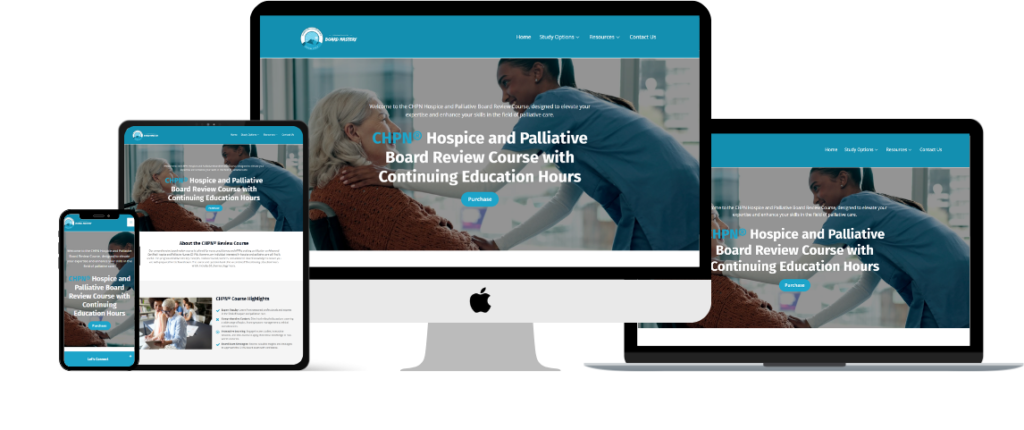
Take your preparation with you wherever you go! Our CHPPN Exam Practice Question Bank features a user-friendly platform optimized for both Android and iOS devices. Access the comprehensive CHPPN question bank and predictor exams on your phone or tablet, allowing you to study anytime, anywhere. Make the most of your time and stay on track to achieve CHPPN certification success.
You receive:
- Access to the mobile responsive platform
- On-demand access anytime, anywhere
Getting Started is Easy!
Getting Started is Easy!
- Sign Up: Create your account on our user-friendly platform.
- Access Resources: Dive into our extensive CHPPN practice question bank and comprehensive CHPPN predictor exams.
- Sign Up: Create your account on our user-friendly platform.
- Access Resources: Dive into our extensive CHPPN practice question bank and comprehensive CHPPN predictor exams.
Our Faculty

Zachary Wagner, MSN, APRN, FNP-C
Zachary Wagner is a nurse practitioner with extensive experience in palliative care. He has held pivotal roles within a palliative care organization, including Nurse Practitioner, Associate Director, and Director. He received his education and training in palliative medicine and primary care from San Francisco State University and Indiana State University, and he holds certification as a Family Nurse Practitioner.

Andrew Wagner, MD
Dr. Andrew Wagner, a distinguished graduate of UC Irvine Medical School, has been a Board Certified Family Physician since 1985. With a notable career in medical education and patient care, he has held esteemed positions such as Chief of Education and served on the Ethics Committee. He is recognized as a pioneer in AIDS/HIV patient care in California. In 2012, he became Board Certified in Hospice and Palliative Medicine, marking a significant shift towards end-of-life care. As a faculty member for the Healer’s Art Course at UCSF, Dr. Wagner focuses on end-of-life and palliative care, sharing his extensive knowledge with medical students. For the past 15 years, he has been a physician facilitator for Schwartz Rounds, promoting discussions about the emotional challenges of patient care. Currently, he provides inpatient palliative care consults at Sutter Health and continues to teach residents. His work is complemented by his training in guided imagery and integrative medicine. In his spare time, Dr. Wagner, a black belt in Aikido, has trained in martial arts for thirty years.

7-Day Trial with 100% Money Back
We are committed to your success. That’s why we offer a 7-day free trial so you can explore the CHPPN Hospice and Palliative Board Review Course with confidence.
Our Promise to You:
- Everything Needed to Pass: Our course provides comprehensive coverage of the CHPPN board exam content, designed and curated by expert faculty to align with the exam blueprint.
- Pass Assurance: If you don’t pass on your first attempt, you’ll receive an additional 6 months of access absolutely free.
- First-Time Success: We are confident that our course equips you with the knowledge and skills necessary to pass the boards on your first attempt.
Start Your CHPPN Journey Today!
Transform the CHPPN exam from a challenge into a milestone in your professional journey. Join our CHPPN Exam Prep community and access the tools, guidance, and support you need to succeed. Empower your career with confidence—your success is our mission!